
Build vs Buy Localization: Hidden AI Costs Explained
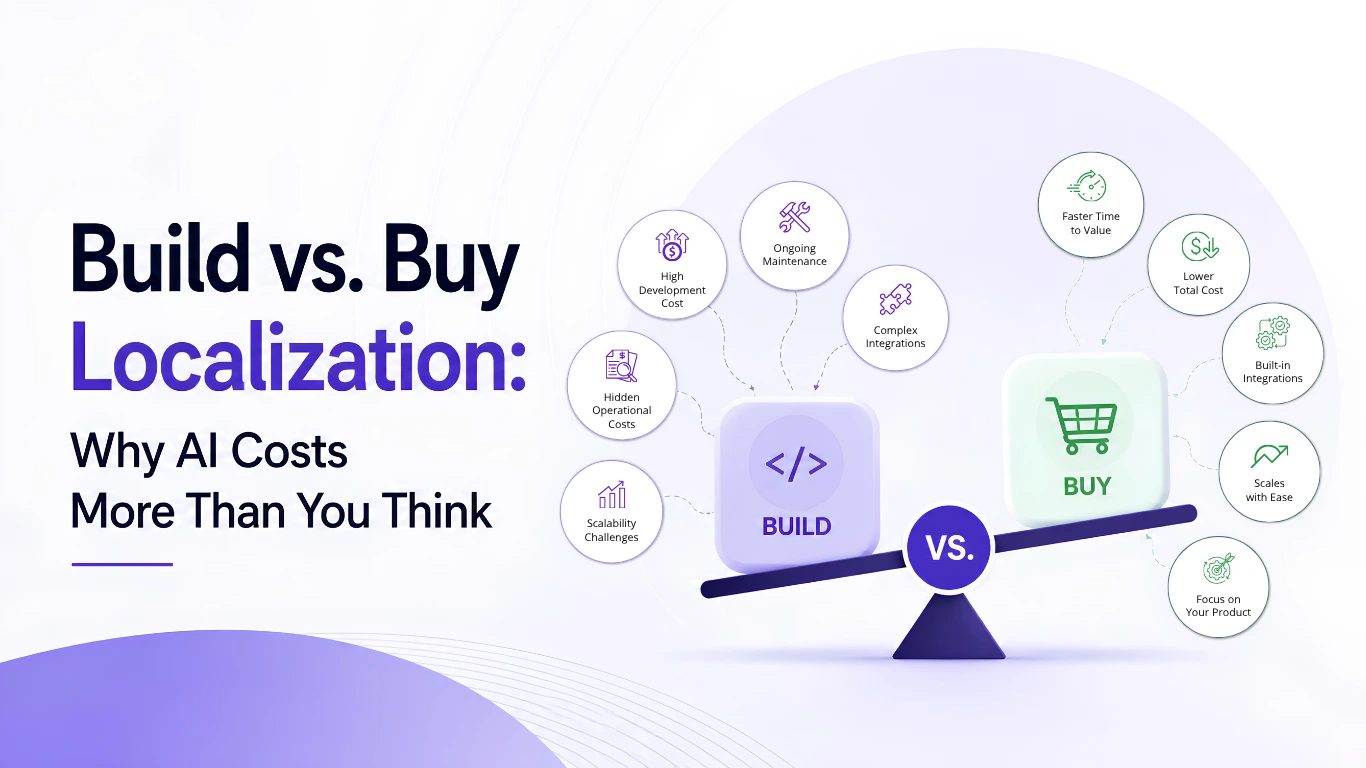
Artificial intelligence has changed how businesses think about software development. Today, there is an AI tool for almost everything, from writing code to generating documentation and even translating content. It is no surprise that many companies ask the same question when planning their localization strategy:
"Why invest in a localization platform when AI can help us build one in-house?"
At first glance, building an internal localization solution seems like the more affordable option. Modern AI models can translate text, generate code, automate workflows, and even review content. It is easy to assume that creating an in-house localization system will save money compared to paying for a translation management system.
Unfortunately, that assumption often falls apart once development begins.
Localization is much more than translating strings. It involves managing thousands of files, coordinating developers and translators, maintaining quality across multiple languages, automating updates, and ensuring every release reaches users without delays.
What looks like a simple internal project can quickly grow into a long-term engineering responsibility.
In this guide, we compare the true cost of building an AI-powered localization solution versus investing in a dedicated translation management system. More importantly, we explore why buying the right platform often delivers a much higher return on investment.
Why More Companies Are Considering Building Their Own Localization Tool
Generative AI has dramatically lowered the barrier to building internal tools.
Developers can use AI assistants to write scripts, create dashboards, integrate APIs, and automate repetitive work much faster than before. As a result, many engineering teams believe they can assemble a basic localization workflow in just a few weeks.
A typical in-house localization stack may include:
-
AI translation models
-
Git repositories for storing translation files
-
Custom scripts for importing and exporting JSON files
-
CI/CD automation
-
Cloud storage
-
Internal review dashboards
Initially, everything appears manageable.
Small applications with one language and a few hundred strings rarely expose major issues. However, as products grow, the complexity increases much faster than expected.
New languages introduce additional workflows.
More contributors create synchronization problems.
Frequent product updates require continuous localization.
Different file formats demand custom handling.
What begins as a simple internal project can soon become a permanent maintenance responsibility.
The Hidden Costs of Building an AI Localization Solution
Most teams focus on the initial development effort. They rarely calculate the cost of maintaining the system for years.
Here are the hidden expenses many organizations overlook.
Engineering Time Never Stops
The first version gets you started. The real work begins afterward.
Every new feature requires updates.
Every framework upgrade may break integrations.
Every API change introduces new maintenance work.
Instead of focusing on customer-facing features, developers spend valuable time fixing localization infrastructure.
Those hours have an opportunity cost.
Every sprint dedicated to internal tooling is a sprint not spent improving your core product.
AI Does Not Replace Localization Management
AI is excellent at translating text.
It is not designed to manage localization workflows.
A complete localization process involves much more than translation, including:
- Version control
- Translation memory
- Context management
- Reviewer collaboration
- Approval workflows
- Quality assurance
- Placeholder validation
- File synchronization
- Release management
Without these capabilities, teams often rely on spreadsheets, manual reviews, and ad hoc communication.
Over time, the workflow becomes slower instead of faster.
Integrations Become Expensive
Modern software rarely exists in isolation.
Localization often touches multiple systems, including:
- GitHub
- GitLab
- Bitbucket
- Jira
- Figma
- CI/CD pipelines
- CMS platforms
- Mobile applications
- Web applications
A single Git integration may require weeks of development, ongoing maintenance, authentication updates, and testing whenever APIs change.
Maintaining them over time becomes another ongoing responsibility.
Scaling Changes Everything
A project with 500 translation keys behaves very differently from one with 50,000.
As applications expand, teams encounter new challenges such as:
- Duplicate translation keys
- Missing translations
- Inconsistent terminology
- Broken JSON files
- Merge conflicts
- Context mismatches
- Delayed releases
AI can generate translations, but it does not automatically solve these operational problems.
Without proper localization management, complexity grows with every release.
Buying a Translation Management System Solves More Than Translation
A modern translation management system is designed to support the entire localization lifecycle.
Instead of stitching together multiple tools, organizations gain a centralized platform that connects developers, translators, designers, and product teams.
This eliminates many manual processes that slow software delivery.
Key capabilities typically include:
- Continuous localization
- Git-based workflows
- Translation memory
- Automated quality checks
- File validation
- Role-based collaboration
- API access
- CLI support
- Localization automation
- Support for JSON, YAML, XLIFF, XML, and other file formats
Rather than building these capabilities from scratch, teams can begin using proven workflows immediately.
The Real Cost Comparison
Many companies compare only the subscription price of a translation management system with the estimated development cost of an internal tool.
That comparison misses the bigger picture.
A more accurate comparison includes the total cost of ownership.
Building In-House
Initial development appears inexpensive.
However, ongoing expenses include:
- Developer salaries
- Infrastructure costs
- API usage
- AI model costs
- Bug fixes
- Maintenance
- Security updates
- Monitoring
- Documentation
- Employee onboarding
- Feature improvements
These costs continue for as long as the tool exists.
Buying a Dedicated Platform
A commercial localization platform has predictable pricing.
Updates, maintenance, security improvements, infrastructure, and new features are handled by the vendor.
Instead of investing engineering resources into localization infrastructure, teams can focus on building products that generate revenue.
That difference becomes increasingly valuable as your software grows.
The Biggest Mistake Companies Make
One of the most common mistakes is assuming that translation is the difficult part.
In reality, translation has become easier thanks to AI.
Managing localization at scale is where complexity begins.
The challenge is not producing translated text.
The challenge is ensuring every translation reaches the correct file, maintains context, passes validation, survives deployment, and remains synchronized with every product update.
That is where dedicated localization platforms create the most value.
And that value compounds with every release.
Build vs. Buy: A Side-by-Side Comparison
When deciding between building an internal localization solution or purchasing a dedicated platform, it helps to look beyond the initial price tag.
| Factor | Build In-House | Buy a Localization Platform |
|---|---|---|
| Upfront cost | Moderate | Low to moderate |
| Long-term maintenance | High | Included |
| Time to launch | Weeks or months | Days |
| AI translation | Requires integration | Built in or easily integrated |
| Git workflow | Custom development | Native support |
| API and automation | Must be developed | Ready to use |
| Collaboration | Custom workflows | Built for translators and developers |
| Quality assurance | Manual or custom | Automated checks |
| Scalability | Engineering dependent | Designed to scale |
| Total cost over time | High | Predictable |
For small internal projects, building your own solution may seem reasonable. But as your application grows, the time spent maintaining localization infrastructure often outweighs the initial savings.
Where AI Delivers the Most Value
AI is transforming localization, but not in the way many teams expect.
The biggest advantage of AI is speed.
It can quickly generate translation suggestions, improve consistency, detect grammar issues, and help translators work more efficiently.
However, AI performs best when it operates within a structured localization workflow.
For example, AI can:
- Translate newly added content
- Suggest terminology based on previous translations
- Detect inconsistencies
- Improve translation quality
- Reduce manual effort
What AI does not do is manage releases, maintain translation history, synchronize repositories, or ensure every localized file reaches production correctly.
The most successful teams combine AI with a robust translation management system instead of trying to replace one with the other.
Why Developer Experience Matters
Localization should fit naturally into the software development process.
When developers have to manually export files, email translators, import updates, and resolve formatting issues, localization becomes a bottleneck.
A developer-first localization platform removes these interruptions.
Instead of changing how your engineering team works, it integrates directly into existing workflows.
Developers can continue using Git, pull requests, CI/CD pipelines, and familiar development tools while localization happens in the background.
Teams can ship updates faster while reducing manual work.
When Should You Build Instead of Buy?
There are situations where building your own solution makes sense.
You may consider an internal tool if:
- Your product supports only one or two languages.
- Localization is rarely updated.
- You have dedicated engineers available for long-term maintenance.
- Your workflow has highly specialized requirements that commercial platforms cannot support.
For most growing SaaS companies, mobile applications, and enterprise software products, these conditions rarely remain true for long.
As products evolve, localization complexity increases, making dedicated platforms the more sustainable choice.
Conclusion
AI has made it easier than ever to build internal tools, but localization requires far more than AI-powered translation. Scaling multilingual software depends on reliable workflows, integrations, collaboration, quality assurance, and ongoing maintenance, not just translation itself.
When deciding whether to build or buy, look beyond the initial development cost and consider the total cost of ownership over the long term. For most growing teams, a dedicated localization platform reduces engineering overhead, accelerates releases, and provides a more scalable and cost-effective way to support global growth.
FAQs
Is AI enough for software localization?
AI is excellent for generating translations, but software localization also requires workflow automation, collaboration, quality assurance, version control, and release management. AI works best when combined with a translation management system.
Is it cheaper to build a localization platform?
The initial development cost may appear lower, but ongoing maintenance, integrations, infrastructure, and engineering time often make an in-house solution more expensive over the long term.
What is a translation management system?
A translation management system helps organizations manage multilingual content through automation, collaboration, translation memory, quality checks, and integrations with development workflows.
Why is continuous localization important?
Continuous localization ensures that translations are updated alongside every product release, helping teams launch new features in every supported language without delays.
How do I choose the right localization solution?
Consider your team's size, release frequency, integration requirements, supported file formats, automation needs, and long-term maintenance costs. For most growing teams, a translation management system provides greater scalability and lower total cost of ownership than building and maintaining an in-house solution.