
What Is the Best LLM for Translation? Top Models Compared
Introduction
The translation industry has been transformed by large language models. Where machine translation once produced clunky, word-for-word output, today’s AI systems can preserve tone, handle idioms, and adapt to cultural context at a level that rivals junior human translators.
But not every AI model approaches translation the same way. Some excel at European language pairs; others shine with low-resource languages or domain-specific terminology. Choosing the wrong tool can cost time, money, and credibility.
This guide breaks down the leading AI translation models available in 2026, compares them across the criteria that actually matter, and gives you a clear framework for picking the right one for your needs.
What Makes an LLM Good at Translation?
Before comparing specific models, it helps to understand what separates a strong AI translator from a mediocre one. Six factors matter most:
- Training data breadth: Models trained on diverse multilingual corpora handle more language pairs and less-common dialects more reliably.
- Contextual understanding: Strong models consider surrounding sentences, not just isolated words. This is critical for pronouns, ambiguous terms, and formal versus informal register.
- Idiomatic and cultural handling: Literal translations often miss the point. The best models recognize phrases that need to be adapted, not just converted.
- Low-resource language support: Languages like Nepali, Swahili, or Welsh are underrepresented in training data. Coverage varies significantly between models.
- Instruction-following: Can you tell the model to use a formal tone, match a glossary, or write for a specific audience? This separates LLMs from older neural machine translation (NMT) tools.
- Consistency in long documents: Terminology drift across a 50-page contract is a real problem. Only newer, long-context models handle this well.
Top AI Translation Models Compared
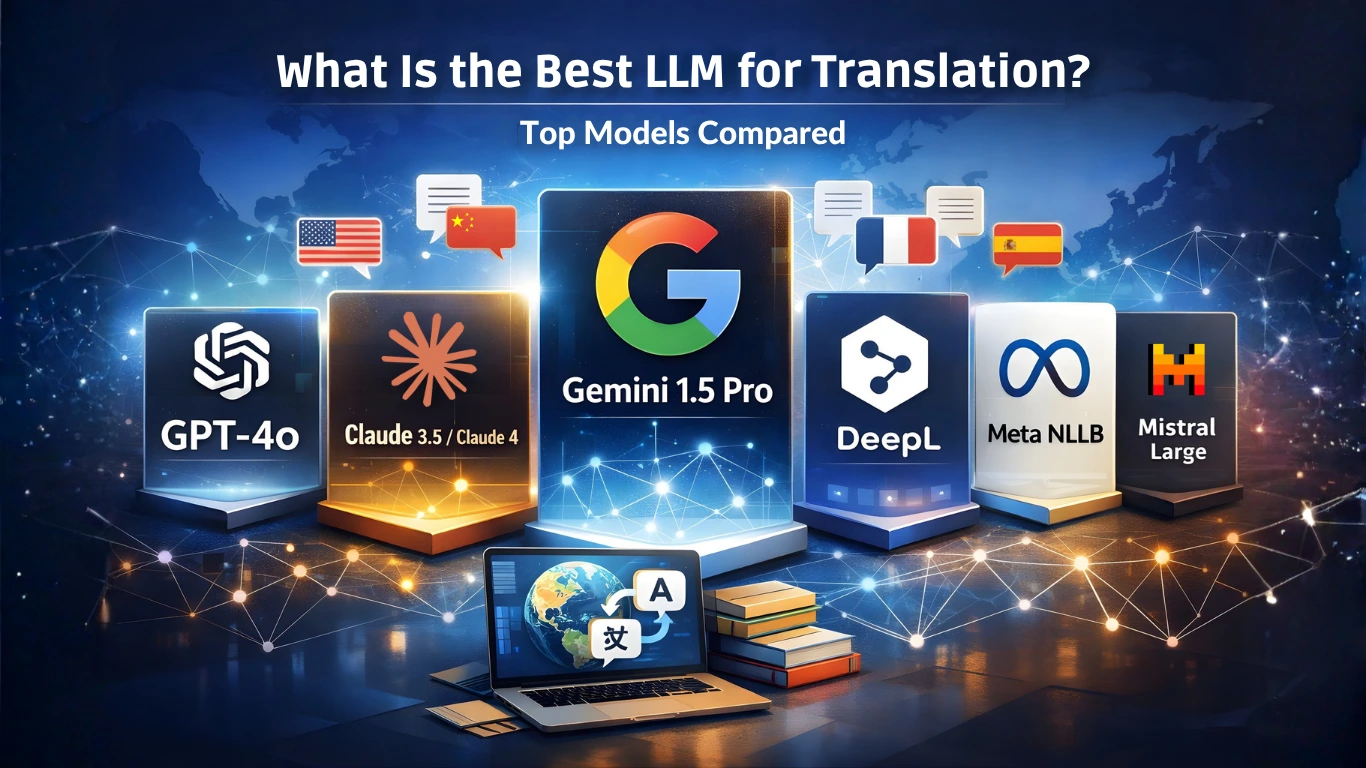
Here is a look at the leading options, each evaluated on quality, language coverage, customizability, and cost.
GPT-4o (OpenAI)
OpenAI’s GPT-4o remains one of the most capable general-purpose translation tools available. Its strength lies in nuanced contextual understanding — it reads tone, adjusts register, and handles complex sentence structures that trip up smaller models.
- Strengths: Broad multilingual coverage, strong at creative and marketing text, excellent instruction-following.
- Weaknesses: Tendency to over-paraphrase in some language pairs; API costs can be significant at scale.
- Best for: General-purpose translation, multilingual customer-facing products, creative content localization.
Claude 3.5 / Claude 4 (Anthropic)
Anthropic’s Claude models are particularly well-suited to formal, tone-sensitive content. Claude responds reliably to detailed instructions—specifying reading level, formality, or target audience produces consistent results. Its long-context window makes it one of the few models that can maintain terminology consistency across lengthy documents.
- Strengths: Tone preservation, instruction-following, strong for legal and professional text, long-document consistency.
- Weaknesses: Slightly narrower low-resource language coverage compared to GPT-4o.
- Best for: Legal documents, formal reports, academic translation, content with strict style guides.
Gemini 1.5 Pro (Google DeepMind)
Gemini benefits from Google’s deep multilingual research and its integration with decades of translation data. The 1.5 Pro model handles up to one million tokens, making it particularly powerful for translating entire books, technical manuals, or video subtitle files.
- Strengths: Long-context translation, multimodal capability (images + text), strong Asian language support.
- Weaknesses: Can produce overly literal translations in idiomatic European text.
- Best for: High-volume translation pipelines, subtitle and audiovisual content, and multimodal tasks.
DeepL
DeepL is not a general large language model—it is a dedicated neural machine translation system, and for European language pairs, it arguably still outperforms every LLM on raw fluency. Human evaluators consistently rate DeepL translations as more natural-sounding than GPT-4 outputs for German, French, Polish, and Spanish.
- Strengths: Best-in-class for EU languages, fast, professional-grade glossary support via DeepL API.
- Weaknesses: Limited to around 30 language pairs; no custom prompting or tone control.
- Best for: Business documents, legal text in European languages, professional localization teams.
Meta NLLB (No Language Left Behind)
Meta’s NLLB model was built specifically to address the gap for underrepresented languages. Released as open source, it supports over 200 languages — including many that GPT-4o and Gemini handle poorly.
- Strengths: Unmatched low-resource language coverage, self-hostable, and no data leaves your infrastructure.
- Weaknesses: Quality ceiling is lower than frontier commercial models for high-resource languages.
- Best for: NGOs, researchers, governments, and developers working with rare or regional languages.
Mistral Large
Mistral’s flagship model offers a strong balance of quality and cost for European language translation. While it trails GPT-4o on complex cultural nuance, it performs well on structured business content and is significantly cheaper to run at scale.
- Strengths: Cost-efficient, solid European language quality, fast inference.
- Weaknesses: Weaker on Asian languages and idiomatic text in non-European pairs.
- Best for: Budget-conscious teams handling high volumes of standard business text.
How Do AI Translation Models Actually Perform? Benchmark Evidence
Several independent benchmarks offer a clearer picture of relative performance:
- FLORES-200: Meta’s benchmark covering 200 languages. GPT-4o and Gemini score highest on high-resource languages; NLLB leads for low-resource pairs.
- WMT (Workshop on Machine Translation): An annual academic competition. DeepL consistently ranks highly for European pairs; GPT-4-class models have shown competitive results in recent editions.
- Human evaluation studies: Third-party studies from translation organizations consistently show DeepL rated highest for EU-language fluency, while GPT-4o and Claude score higher for tone and instruction adherence.
Source: https://www.nature.com/articles/s41586-024-07335-x
Choosing the Right AI Translation Tool for Your Use Case
Rather than declaring one model the universal winner, the smarter approach is matching the tool to the task:
- Legal and medical documents: Claude or DeepL Pro. Both prioritize precision and can follow strict terminology requirements.
- Marketing and creative copy: GPT-4o or Claude. Creative localization requires cultural adaptation, not just linguistic accuracy.
- Real-time chat and customer support: GPT-4o mini or Gemini Flash. Speed and cost efficiency matter more than perfection at this scale.
- Low-resource and regional languages: Meta NLLB. No other model comes close for breadth of coverage.
- Subtitle and audiovisual content: Gemini 1.5 Pro. Its long-context window handles full scripts without losing coherence.
- Privacy-sensitive or on-premise workloads: LLaMA 3 or Mistral (self-hosted). No data leaves your servers.
How to Get Better Translation Results from Any LLM
Even the best model produces mediocre output without a well-crafted prompt. These techniques apply to all instruction-following LLMs:
- Specify your audience and purpose: “Translate this press release for a Japanese business audience, using the formal Keigo register.”
- Attach a glossary: Provide a table of preferred term translations for domain-specific vocabulary. This dramatically reduces inconsistency.
- Request back-translation: Ask the model to translate your output back to the source language. Divergence from the original flag’s potential errors.
- Use chain-of-thought prompting: “Translate this text, then note any idioms or cultural references you adapted and explain why.” This surfaces hidden decisions.
- Break long documents into sections: For models without large context windows, chunking text and providing shared glossary context between calls preserves consistency.
Where AI Translation Still Falls Short
AI translation has advanced enormously, but several limitations remain:
- Hallucination of proper nouns: Models occasionally invent names, dates, or technical terms. Always review outputs for factual claims.
- Dialect and regional variation: “Spanish” spans over 20 distinct regional varieties. Most models default to a neutral standard without being instructed otherwise.
- Cultural sensitivity: Humor, taboo subjects, and cultural references do not transfer automatically. Human review remains essential for consumer-facing content.
- Data privacy: API-based models send your text to third-party servers. For confidential content, self-hosted or on-premise solutions are a safer choice.
- Post-editing still required: For certified translations—legal, medical, or regulatory—human review is not optional. AI output should be treated as a high-quality draft, not a finished product.
Conclusion
There is no single answer because the best AI translation model depends on what you are translating, into which language, and under what constraints. For most general-purpose needs, GPT-4o and Claude offer the strongest combination of accuracy, instruction-following, and language coverage.
The most effective approach is to test two or three models against your actual content before committing to a workflow. Benchmark scores are a useful starting point, but performance on your specific domain, tone, and language pair is what matters. For a deeper perspective on quality and nuance, you can also explore Human vs. AI Translation to understand where machines excel and where human expertise still plays a critical role.
FAQ
Is GPT-4 better than DeepL for translation?
It depends on the language pair and content type. GPT-4o outperforms DeepL on creative content, tone-sensitive text, and languages outside DeepL’s supported pairs. DeepL typically produces more natural-sounding output for business and legal text in European languages.
Can AI translate legal documents accurately?
AI models can produce high-quality drafts of legal documents, but certified or legally binding translations still require human review. Claude and DeepL Pro are the most commonly used for this purpose, given their precision and glossary support.
Which free AI translation tool delivers the best results?
Google Translate remains the most accessible free option for casual use. For developers, Meta’s NLLB is the strongest open-source model, particularly for low-resource languages.
How accurate is AI translation compared to human translators?
For common language pairs and standard content, frontier AI models now approach the quality of a competent junior human translator. However, they consistently trail experienced professional translators on culturally nuanced, creative, or highly specialized text.
Which AI translates rare languages best?
Meta’s NLLB (No Language Left Behind) model is specifically designed for low-resource languages and supports over 200 languages — far more than any commercial LLM.