
Human vs. AI Translation: Which Is Best for Your Brand?
If your brand spoke to the world today, would your message truly connect?
In a global market where your words travel instantly, one small phrase can shape how people see you.
So ask yourself, are you speaking the right language the right way?
That is where the conversation around human vs. AI translation becomes more important than ever. Brands are now balancing speed with accuracy, cost with quality, and automation with authenticity. This blog dives deep into which option truly serves brands best in 2025 and beyond.
What is Translation, and Why Does It Matter for Modern Brands?
Translation is no longer just a linguistic process. It has evolved into a strategic business function that impacts brand trust, customer experience, and global growth. Whether you are localizing websites, adapting marketing campaigns, handling legal documentation, or supporting multilingual customers, your translation choices shape how people perceive your brand.
As companies expand globally, one wrong word, one cultural misinterpretation, or one misplaced phrase can trigger localization mistakes that damage credibility. Yet when done right, translation becomes a brand advantage rather than a cost center.
With that in mind, let’s break down how human and AI translation work and which option fits your goals.
AI Translation
AI translation tools use machine learning, neural networks, and natural language processing to convert text from one language to another. Popular AI-driven engines have improved dramatically in the last decade. They now rely on huge datasets, predictive modeling, and context-aware algorithms to produce faster and more accurate translations than ever before.
Strengths of AI translation include:
- Instant results
- Low operational costs
- Improved accuracy over time
- Good performance for general or repetitive content
- Integration with SaaS platforms, CMS, and automation systems
AI translation has become a standard solution for brands handling large volumes of user-generated content, support tickets, product listings, and internal communication.
Human Translation
Human translators bring something AI currently cannot reproduce: emotional intelligence and cultural understanding.
A professional human linguist interprets not just words but also tone, intent, and cultural subtext. This is essential for marketing, legal language, brand storytelling, and sensitive content where nuance can make or break the message.
Strengths of human translation include:
- Deep cultural context
- Accuracy for specialized fields
- Ability to capture brand voice
- Customization for market expectations
- Creative flexibility
Strategies like transcreation often require a human touch because they involve adapting meaning rather than simply translating words.
Differences Between Human and AI Translation
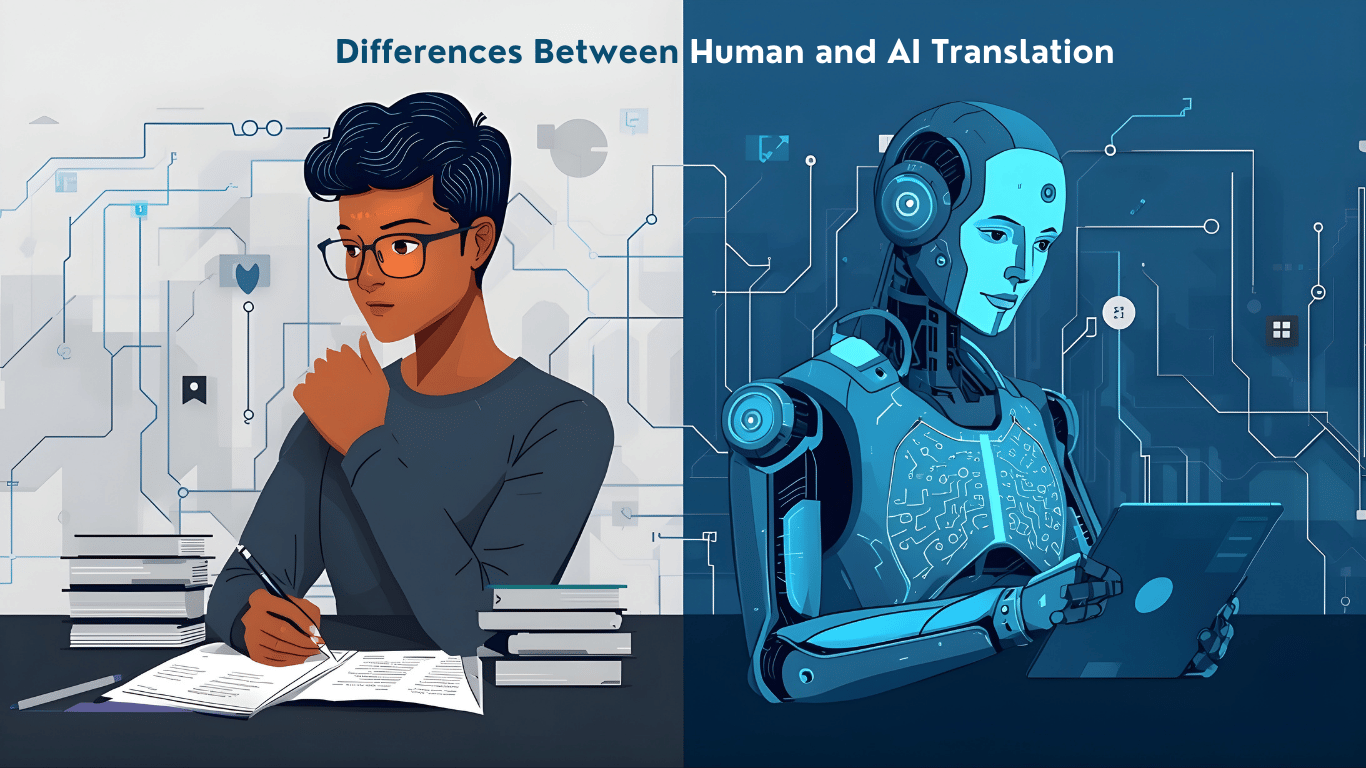
Below is a clear table comparing the two:
Human vs. AI Translation Comparison Table
| Aspect | Human Translation | AI Translation |
|---|---|---|
| Accuracy | High, especially for context-heavy or nuanced content | Good for general text, less reliable with idioms or culture |
| Speed | Slower due to manual processing | Instant or near-instant |
| Cost | Higher, varies by expertise and language pair | Lower, subscription, or per-character |
| Cultural Understanding | Excellent, captures tone and emotion | Limited, often literal |
| Consistency | Maintained through expertise and tools | Very high across large-scale content |
| Best For | Marketing, legal, creative, high-stakes content | Product descriptions, user-generated text, bulk tasks |
| Limitations | Time-consuming, costlier | Risk of errors, lacks emotional intelligence |
Even though AI has evolved advanced rapidly, several clear distinctions remain. Understanding these differences helps brands decide when to automate and when to rely on expert linguists.
1. Accuracy and Context
- AI performs very well with structured content but struggles with idioms, emotion, cultural references, or humor.
- Humans understand intent, tone, and social nuances that algorithms often miss.
2. Speed
- AI produces instant results, making it ideal for large-scale or fast-paced workflows.
- Humans take longer, but the quality is superior for high-impact content.
3. Consistency
- AI maintains uniform terminology across large datasets.
- Humans ensure consistency through expertise, memory tools, and brand guidelines.
4. Quality of Expression
- AI tends to be literal.
- Humans refine wording to sound natural, persuasive, and aligned with brand personality.
5. Best Use Cases
AI Works Best For:
- Product descriptions
- User-generated content
- Basic customer support answers
- Internal communication
- High-volume text
Humans Excel At:
- Marketing campaigns
- Website copy
- Legal and medical content
- Cultural adaptation
- Storytelling and brand messaging
This difference becomes crucial when evaluating why global businesses fail in new markets. Often, miscommunication and cultural insensitivity play a bigger role than the product itself.
Hybrid Approach: The Smartest Strategy for Most Brands
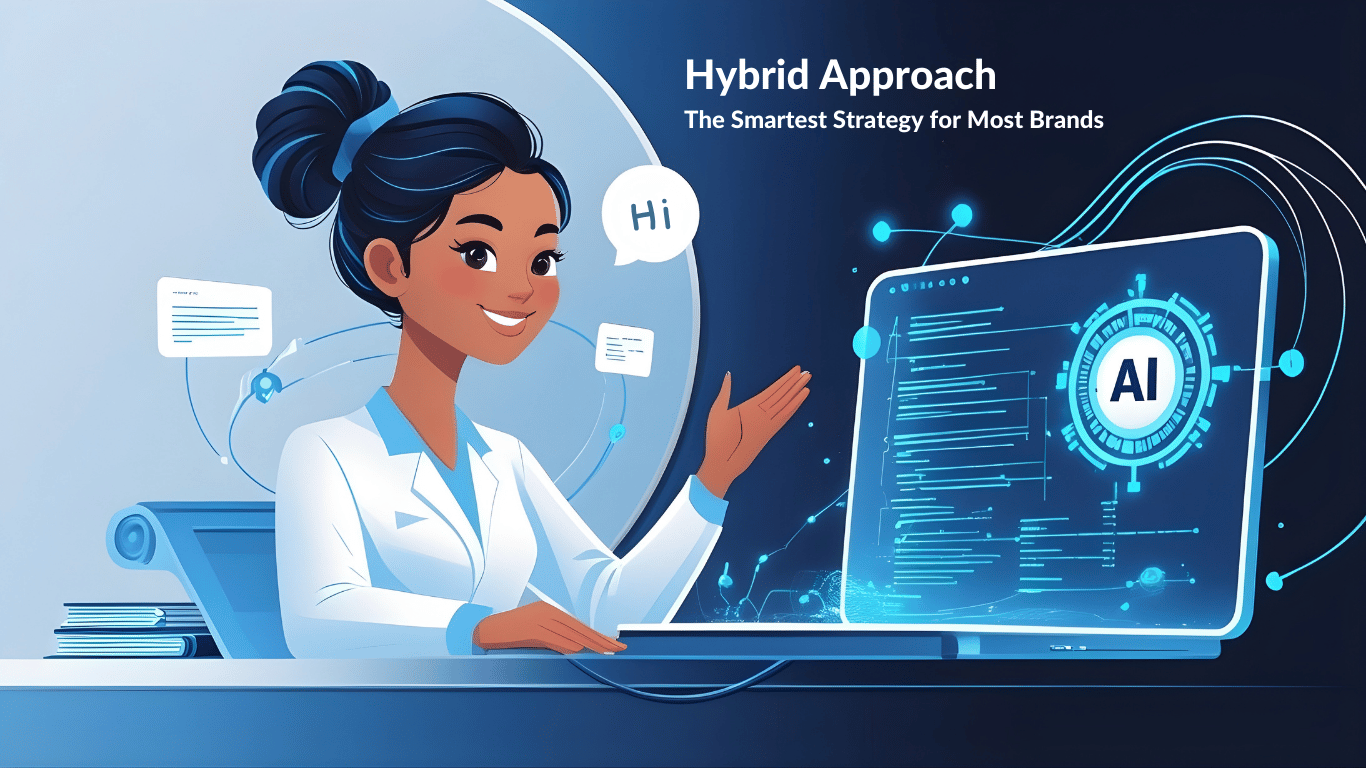
Many modern companies are no longer choosing between human or AI translation exclusively. Instead, they are combining both to maximize quality, speed, and cost-efficiency.
How the Hybrid Model Works
- AI handles the first draft using neural machine translation.
- Human linguists refine, correct, and localize the content.
- Quality assurance tools finalize consistency, grammar, and industry-specific terminology.
This model is especially useful for businesses managing large multilingual ecosystems such as
- E-commerce product catalogs
- Software interfaces
- Global marketing campaigns
- Customer experience operations
- Industry reports and knowledge bases
Benefits of the Hybrid Approach
- Faster turnaround
- Reduced costs compared to full human translation
- High accuracy and brand consistency
- Scalable for global operations
- Better handling of localization challenges
This approach especially shines when dealing with complex material such as types of translation required for various industries, from legal to multimedia adaptation.
Human vs. AI Translation: Which Is Better for Your Brand?
There is no one-size-fits-all answer. Instead, the choice depends on your goals, content type, budget, and desired quality level.
Choose AI Translation If:
- Speed is the priority
- Content is high-volume and low-risk
- You need scalable solutions integrated with digital tools
- Accuracy is less critical
Choose Human Translation If:
- Brand image and tone matter
- Content requires cultural adaptation
- Mistakes could lead to legal or reputational issues
- You are creating content meant to persuade, sell, or inspire
Choose a Hybrid Approach If:
- You want high quality at a balanced cost.
- You manage ongoing multilingual projects.
- You want reliable brand consistency.
- You want technology plus human nuance.
A strong translation strategy ensures clarity, connection, and trust as your brand enters global markets. It prevents localization mistakes, secures customer loyalty, and strengthens long-term growth.
How to Determine the Best Fit for Your Brand
Here are the key questions to guide you through your decisions:
1. What is the purpose of the content?
Marketing copy, brand messaging, and legal content require human involvement. Product listings, support responses, and large datasets are perfect for AI.
2. What is your acceptable margin of error?
If stakes are high, choose human or hybrid.
3. What is your timeline?
AI is unmatched for speed. Human translators require time but provide superior accuracy.
4. What impression do you want your brand to create?
If your brand prioritizes quality, emotion, and trust, human translation or hybrid systems reflect that value.
5. What markets are you targeting?
Cultures with unique linguistic structures often benefit from human insight.
Conclusion
In the end, the real winner is not human vs. AI translation. The real winner is the strategy that aligns with your brand’s goals.
- If you value speed, AI gives you a competitive edge.
- If you value authenticity and emotional resonance, humans are irreplaceable.
- If you need the best of both worlds, hybrid translation delivers the most balanced solution.
Your brand deserves a voice that feels natural, culturally aware, and globally relevant. Choosing the right translation method is not just a technical decision. It is a strategic investment in how your brand connects with the world.
FAQ
Can AI fully replace human translators in the future?
Not likely anytime soon. While AI translation is getting faster and smarter, it still struggles with cultural context, tone, and emotional nuance. Human translators remain essential, especially for brand messaging, creative work, and tasks that go beyond simple language conversion such as translation vs localization, where cultural adaptation plays a key role.
How do human translation and AI translation differ?
Here’s a quick comparison:
- Human translation focuses on meaning, tone, and cultural relevance.
- AI translation focuses on speed, automation, and large-volume text.
Humans ensure natural, brand-aligned language, whereas AI offers quick results but may misinterpret context.
What are the key benefits of using AI translation?
AI translation offers several advantages:
- Extremely fast turnaround
- Cost-effective for bulk content
- Easy integration into digital tools and platforms
- Useful for repetitive or general text
- Helps scale multilingual operations quickly
Which option is better for businesses, human translation or AI translation?
It depends on your goals and the type of content.
- Choose human translation when accuracy, emotion, and cultural clarity matter.
- Choose AI translation for speed, high-volume text, and low-risk content. Most brands benefit from a hybrid approach, combining AI efficiency with human quality.
What is an example of a poor AI translation?
A common example is when AI directly translates idioms or slang. For instance, turning "break a leg" into a literal phrase in another language instead of conveying the intended meaning of "good luck." This shows how AI can misunderstand cultural context and produce awkward or misleading results.