
Why Developers Hate Managing Translation JSON Files
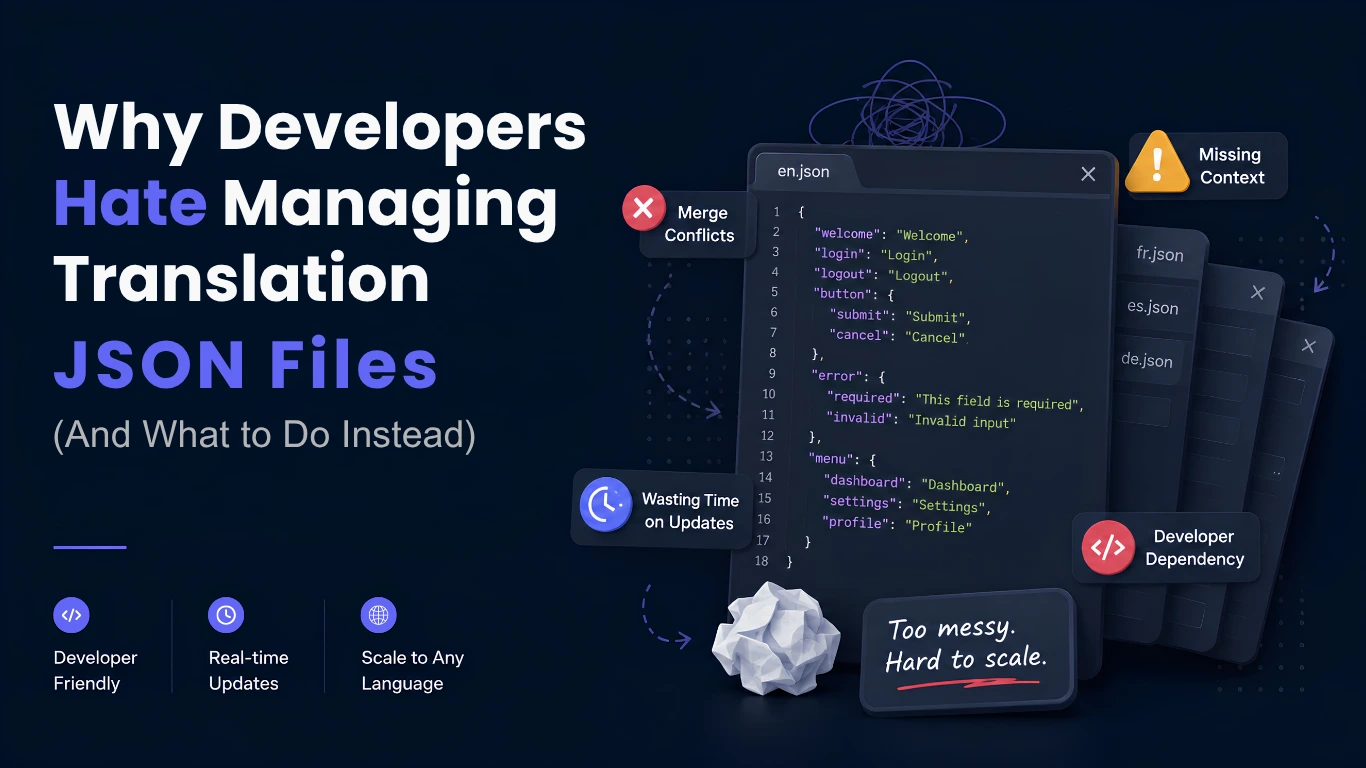
As applications grow, localization often starts with a simple solution: JSON files.
At first, the approach feels practical. Developers create a translation file, add localized strings, and load them into the application through a localization framework. The setup is lightweight, easy to understand, and requires little additional infrastructure.
A typical translation file might look like this:
For a small application with one or two languages, this approach works perfectly well.
The problem is that products rarely stay small.
As new features are introduced, teams expand, and businesses enter new markets, translation files begin to grow rapidly. What once contained a few dozen strings can quickly become thousands of translation keys spread across multiple files, languages, and environments.
At that point, managing translation JSON files often becomes one of the most frustrating aspects of the development workflow.
If you've ever spent hours searching for missing keys, resolving merge conflicts, coordinating with translators, or deploying minor text changes, you're not alone.
Let's explore why developers struggle with translating JSON files and how modern localization workflows solve these challenges.
The Problem Starts Small
Most localization challenges don't appear immediately.
In the early stages of development:
- There are only a few translation keys.
- One developer manages updates.
- New languages are added infrequently.
- Changes happen within a single codebase.
As the application grows, however, localization complexity increases alongside product complexity.
- New features introduce new strings.
- Marketing teams request content updates.
- Product managers refine messaging.
- Translators require context.
- Developers work simultaneously on multiple releases.
Before long, the localization workflow that once felt simple starts creating friction across the entire organization.
1. Translation Files Become Difficult to Organize
One of the first challenges developers encounter is organization.
As applications scale, translation files often contain:
- Thousands of translation keys
- Multiple language variations
- Feature-specific content
- Shared interface elements
- Legacy strings that are no longer used
Without a clear structure, translation files become increasingly difficult to navigate.
Consider the following example:
All three keys serve the same purpose.
Yet each follows a different naming convention.
As more developers contribute to the project, inconsistencies multiply. Some developers use camelCase, others prefer snake_case, and some create entirely new naming patterns.
The result is clutter, duplication, and confusion.
Developers waste time searching for existing keys, accidentally create duplicates, and struggle to maintain consistency across the codebase.
What should be a simple localization task becomes increasingly difficult to manage.
2. Merge Conflicts Slow Down Development
Localization files are often shared resources.
This means multiple developers may update the same file simultaneously.
Imagine several developers working on separate features:
- One adds new onboarding text.
- Another update to checkout messages.
- A third modifies account settings.
All changes occur in the same translation file.
When these updates are merged into the main branch, conflicts become inevitable.
Developers must then spend time:
- Reviewing changes
- Resolving conflicts
- Restoring missing translations
- Testing affected functionality
These tasks add no direct value to the product.
Instead of shipping features, teams spend valuable development time managing translation files.
As language support expands, the problem becomes even more severe because every additional language introduces another set of files requiring synchronization.
3. Missing Context Creates Poor Translations
Translation quality depends heavily on context.
Unfortunately, JSON files rarely provide enough information for translators to fully understand how a string is used.
Consider this example:
The word "Open" could mean several different things:
- Open a document
- Open a navigation menu
- Open a support ticket
- Open a business account
Without context, translators are forced to guess.
This often leads to:
- Incorrect translations
- Inconsistent terminology
- User confusion
- Additional review cycles
The problem becomes even more pronounced in languages where meaning changes significantly depending on context.
As a result, teams spend additional time reviewing, correcting, and re-translating content that could have been translated correctly the first time if sufficient context had been provided.
4. Translation Updates Depend on Developers
In traditional JSON-based workflows, every translation change often requires developer involvement.
A typical update process looks like this:
- Modify the translation file
- Commit the change
- Create a pull request
- Review the code
- Merge the update
- Deploy a new release
Even minor text changes can trigger the entire deployment process.
This creates unnecessary dependencies between teams.
As a result:
- Product managers wait longer for updates.
- Marketing teams cannot quickly modify messaging.
- Translators depend on engineering resources.
- Developers become bottlenecks for simple content changes.
Localization should accelerate global growth, not slow it down.
Yet for many organizations, managing translations through code creates unnecessary friction across departments.
5. Scaling Languages Multiplies Complexity
Adding a second language is usually straightforward.
Adding ten languages is a completely different challenge.
Each new language introduces:
- Additional translation files
- More review requirements
- Larger maintenance overhead
- Increased QA complexity
- Greater risk of inconsistencies
For example, a product supporting:
- English
- Spanish
- French
- German
- Japanese
- Korean
- Portuguese
- Italian
must maintain multiple versions of every user-facing string.
If one translation key changes, every language file may require updates.
Without an efficient workflow, localization complexity grows faster than the product itself.
What began as a simple translation system eventually becomes a significant operational burden.
6. Maintaining Consistency Across Teams Becomes Difficult
As organizations grow, localization becomes a cross-functional effort.
Developers, translators, marketers, product managers, and customer success teams may all contribute to localized content.
Without centralized management, teams often encounter:
- Different terminology across languages
- Duplicate content creation
- Inconsistent brand messaging
- Conflicting translation updates
For global brands, consistency matters.
A fragmented localization process can negatively impact user trust and create a less professional experience for international audiences.
A Better Approach: Modern Localization Workflows
Modern localization platforms are designed to solve the limitations of translating JSON files.
Rather than treating translations as static files, these platforms centralize localization management and streamline collaboration between teams.
Modern workflows allow organizations to
Centralize Translation Management
Store all translations in a single source of truth instead of managing multiple files across repositories and environments. This improves consistency, visibility, and collaboration across teams.
Organize Content Using Namespaces
Group translations by feature, page, or workflow to keep content structured and easy to navigate. This helps developers find and manage translation keys more efficiently.
Provide Context for Translators
Attach screenshots, descriptions, and usage notes to translation strings so translators understand where and how content is used. Better context leads to more accurate translations.
Enable Real-Time Updates
Publish translation changes instantly without modifying code or triggering new deployments. This allows teams to update content faster and respond quickly to business needs.
Reduce Developer Dependency
Allow translators, marketers, and product teams to manage content updates independently. This frees developers to focus on building features instead of handling text changes.
Scale More Efficiently
Add and manage new languages through centralized workflows rather than maintaining separate files manually. This reduces complexity and supports global growth more effectively.
The result is a faster, more collaborative localization process that benefits developers, translators, product teams, and end users alike.
Conclusion
Translation JSON files are not inherently bad.
In fact, they are often the perfect starting point for small applications and early-stage products.
However, as applications scale, the limitations of manual translation management become increasingly apparent.
What begins as a simple file quickly evolves into a source of technical debt, operational overhead, and development bottlenecks.
Developers should not have to spend hours resolving merge conflicts, searching for translation keys, coordinating updates, or deploying minor text changes.
A scalable localization workflow enables teams to focus on building great products while delivering consistent multilingual experiences to users around the world.
As global applications continue to grow, organizations that invest in modern localization processes early will be better positioned to scale efficiently, improve translation quality, and accelerate international expansion.
FAQ
Why do developers use JSON files for translations?
JSON files are lightweight, easy to implement, and supported by most localization frameworks. They allow developers to store and retrieve localized content without requiring external services.
What are the biggest challenges of managing translation JSON files?
Common challenges include merge conflicts, inconsistent naming conventions, missing translation context, duplicated strings, developer dependencies, and increased maintenance as applications scale.
Why are merge conflicts common in localization files?
Multiple developers often modify the same translation files simultaneously. When these changes overlap, version control systems generate conflicts that must be resolved manually.
How does missing context affect translation quality?
Without information about where and how a string is used, translators may misunderstand its meaning. This can lead to inaccurate translations, inconsistent terminology, and poor user experiences.
What is a localization management platform?
A localization management platform centralizes translation workflows, enabling teams to manage content, collaborate with translators, automate updates, provide context, and maintain consistency across multiple languages.