
In-Context Translation Editing for Effortless Global Launches
Imagine launching your app in Spain and your “Buy Now” button reads “Cry Now.” Users click and panic. Simple translation isn’t enough. Your product must speak naturally in every language while keeping your brand voice. In-context translation editing lets teams fix mistakes live, making global launches smooth and avoiding funny disasters.
Clocale’s In-Context Editing takes this process to the next level, letting teams manage translations directly in the product interface, making global launches smoother, faster, and more accurate.
What Is In-Context Translation Editing?
In-context translation editing is a process where translations are done directly within the product interface, allowing teams to see exactly how text appears to users. Instead of translating words in isolation, it preserves tone, layout, and context across languages.
For product teams, this reduces errors, speeds up launches, and ensures a seamless user experience. When a product speaks naturally in every language, engagement, trust, and retention increase.
Why Traditional Translation Methods Fail
Even the most diligent translation teams face hurdles with conventional methods:
- Lack of context: Translators often work with spreadsheets or text files that don’t show how the content will appear in the interface, leading to awkward phrasing or errors.
- Slow iteration: Multiple rounds of review, feedback, and reintegration of translated text slow down product releases.
- High developer dependency: Developers frequently need to implement translations manually, creating bottlenecks.
- Inconsistency across platforms: Without a unified system, translations can vary between web, mobile, and desktop versions.
These challenges highlight the need for a more integrated approach to translation management, one that brings the text into its real environment.
The Benefits of In-Context Translation Editing
Faster Global Launches
By editing translations directly in the product, teams can immediately see how text fits and flows. Adjustments can be made on the spot, eliminating the back-and-forth of traditional translation workflows. This accelerates launch timelines and reduces errors that could confuse users.
Improved Accuracy and Context
Words often change meaning depending on placement. A word like “charge” could refer to a financial transaction on one screen and a battery status on another. In-context editing ensures translations are accurate, contextually appropriate, and easy to understand.
Reduced Developer Workload
With in-context translation editing, product teams can update content without relying on developers to implement changes. This allows developers to focus on features and functionality, while translators and content managers maintain quality control.
Enhanced Collaboration
In-context editing fosters seamless collaboration between translators, designers, and product managers. Teams can make edits, provide feedback, and approve translations in real time, ensuring that the final product is polished, cohesive, and ready for a global audience.
Consistent Brand Voice Across Languages
In-context translation editing helps maintain a consistent tone and style across all markets. By seeing translations in their real context, teams can ensure that messaging aligns with the brand, avoiding awkward or inconsistent phrasing that could confuse users.
Faster Iteration and Updates
Products evolve constantly, and content changes frequently. In-context editing allows teams to quickly update translations and test them live, ensuring new features or text changes are instantly localized without delays, keeping your global product experience up-to-date.
How Clocale’s In-Context Editing Makes a Difference
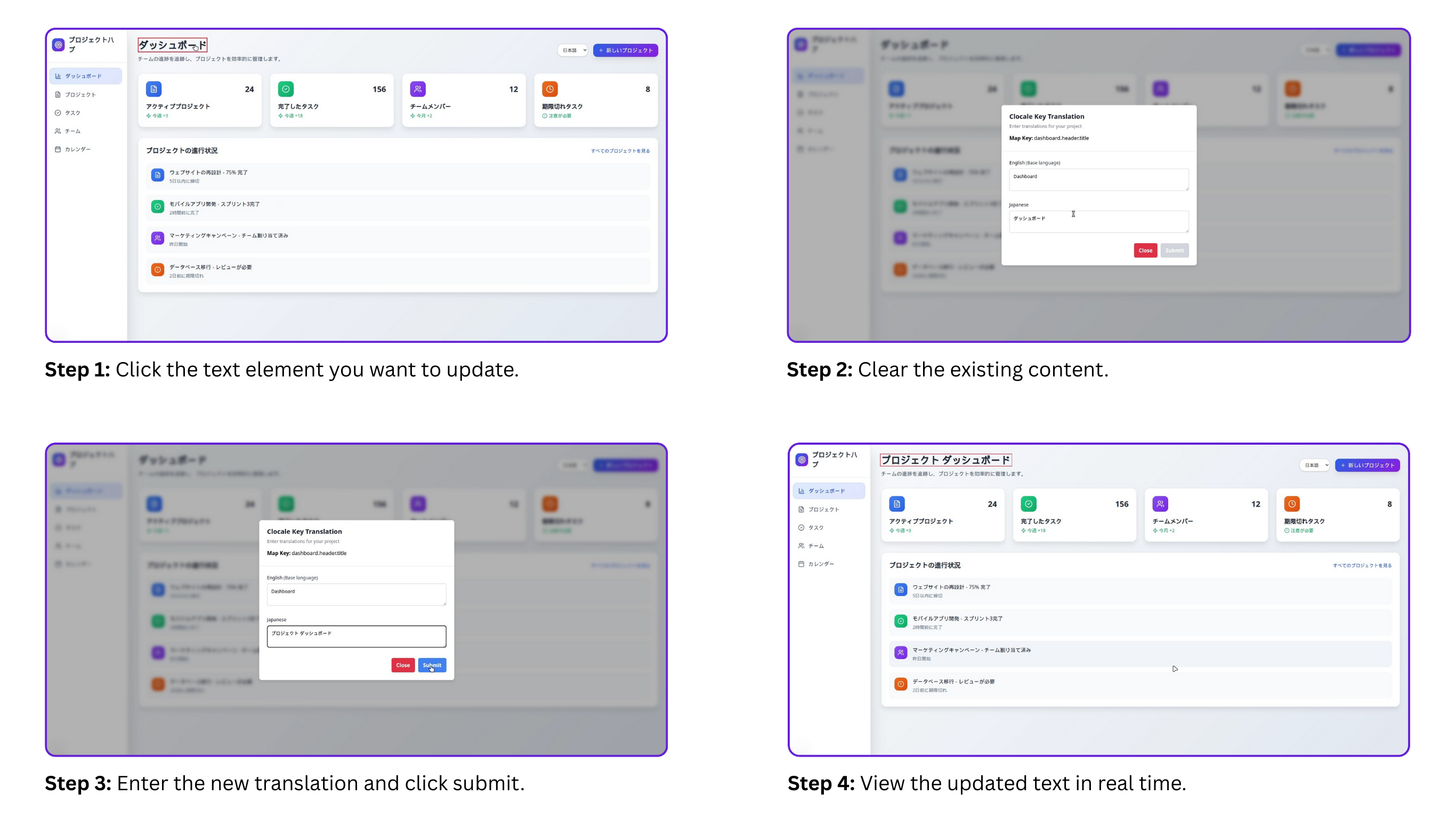
Clocale’s In-Context Editing is designed specifically to solve the challenges of traditional translation workflows. Unlike generic translation tools, it integrates directly with your product interface, allowing your team to manage translations efficiently and accurately.
Here’s how Clocale’s feature stands out:
-
Live product editing: Translate and adjust content while seeing it exactly as users will encounter it.
-
Collaborative interface: Invite translators, product managers, and designers to edit, comment, and approve content simultaneously.
By leveraging Clocale, product teams can reduce launch delays, improve translation quality, and maintain consistent messaging across all markets.
Best Practices for Implementing In-Context Translation Editing
Transitioning to in-context translation editing requires a thoughtful approach. Here are some best practices:
- Centralize Translation Management: Use a single platform like Clocale to store, manage, and update translations. This ensures consistency and reduces duplication.
- Prioritize High-Impact Screens: Focus on critical user flows such as onboarding, checkout, and settings pages first. This ensures users experience key content in their native language.
- Leverage Translation Memory: Reuse previously approved translations to maintain consistency and speed up the workflow.
- Involve Cross-Functional Teams: Collaboration between designers, translators, and product managers ensures translations are accurate, contextually relevant, and visually aligned with your product.
- Regularly Update Translations: Keep translations current as your product evolves, ensuring that new features or content are correctly localized.
How In-Context Translation Enhances User Experience
Global users are more likely to engage with products that feel native to them. In-context translation improves the user experience in several ways:
- Clarity and comprehension: Users can quickly understand your product’s functionality and messaging.
- Cultural relevance: Content resonates with local audiences, enhancing trust and satisfaction.
- Consistency across devices: Your message remains consistent whether users are on web, mobile, or desktop, reinforcing brand identity.
- Faster feature adoption: Users can easily navigate and use new features when translations are accurate and contextually relevant.
- Enhanced engagement: Context-aware translations make users feel the product was designed for them, increasing interaction and retention.
Real-World Impact of In-Context Translation Editing
Organizations that adopt in-context translation editing see tangible benefits:
- Faster time-to-market: Immediate updates reduce launch delays.
- Fewer translation errors: Contextual visibility prevents awkward or incorrect phrasing.
- Higher user satisfaction: Users engage more with content that feels localized and natural.
- Reduced developer dependency: Product teams can update content without waiting for developers, freeing up engineering resources.
- Improved collaboration: Translators, designers, and product managers can work together in real time, speeding up approval workflows.
- Better conversion rates: Accurate, context-aware translations help users understand product features, boosting onboarding, sales, and retention.
Conclusion
Launching globally is challenging, but Clocale’s In-Context Editing makes translation simple, accurate, and user-friendly. It reduces developer work and keeps content consistent across all platforms.
For teams reaching international audiences, it’s more than a workflow improvement. It’s a strategic advantage that turns global expansion into growth and engagement opportunities.
FAQ
What is in-context translation editing?
In-context translation editing allows translators and product teams to view and edit translations directly within the product interface. This ensures that text fits perfectly, maintains the right tone, and aligns with the product’s design. Unlike traditional translation methods, it reduces errors and improves user experience across languages.
How does Clocale’s In-Context Editing work?
Clocale’s In-Context Editing integrates directly with your product, letting teams translate, adjust, and approve content in real time. It supports live previews and collaborative editing, making global launches faster and more accurate.
Why is in-context translation important for product teams?
In-context translation ensures that users see accurate, culturally relevant text in the right context. It prevents common translation errors, improves usability, maintains brand voice, and speeds up international product launches, which is critical for SaaS platforms, e-commerce apps, and global products.
Can in-context translation editing improve SEO?
Yes. By translating content in context, teams can naturally integrate target keywords for local search engines while maintaining readability. This improves organic search visibility, drives traffic from international markets, and enhances brand presence globally.
How can product teams implement in-context translation effectively?
The best approach includes centralizing translation management with tools like Clocale, involving cross-functional teams, prioritizing high-impact screens, leveraging translation memory, and regularly updating content. This ensures accurate, consistent, and efficient translation across all platforms.