
How much does app localization actually cost in 2026?
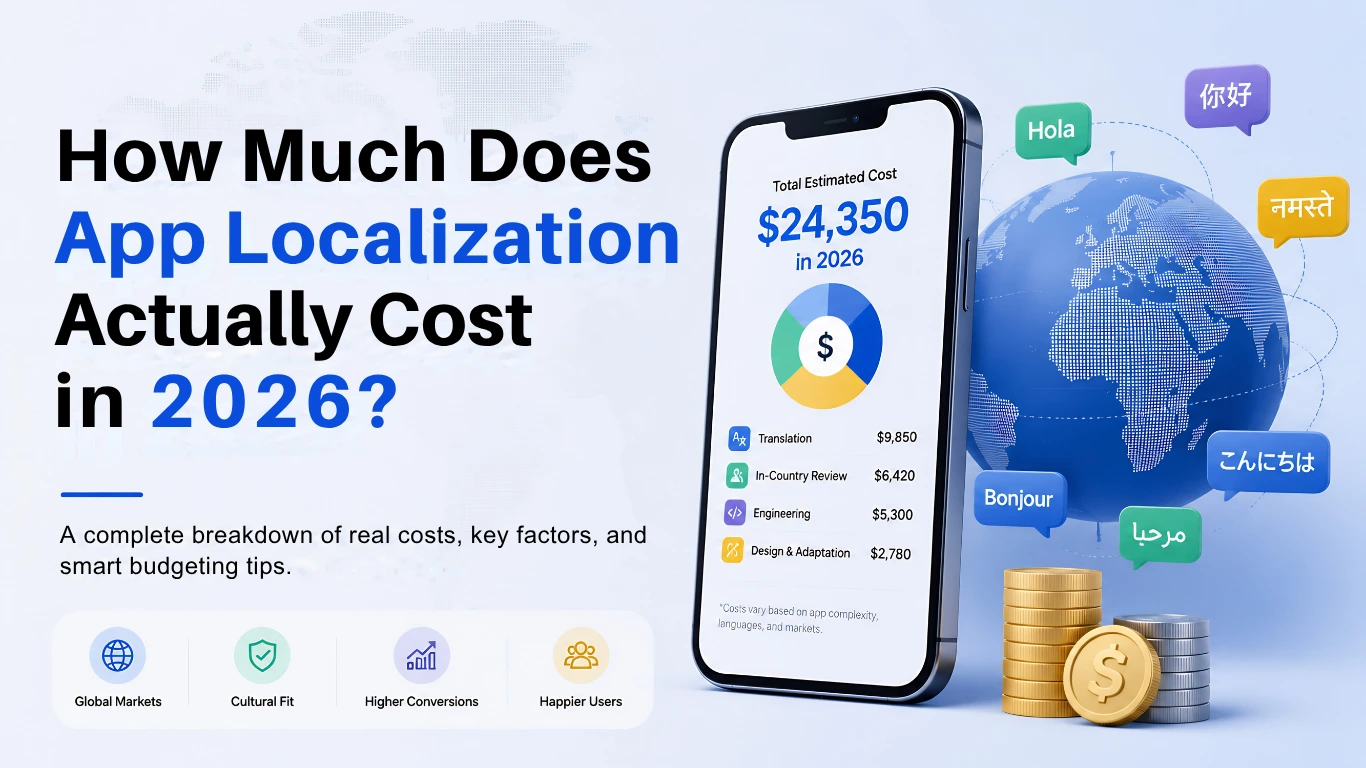
You’ve built a great app. Your metrics look strong. Now the question being raised is, "What's stopping us from localizing yet?”
So, you search for app localization cost and get almost nothing useful. Vague ranges. “It depends.” A phrase commonly found in vendor landing pages framed as guides.
Here’s the honest answer: app localization typically costs between $3,000 and $60,000+ depending on your app’s size, the number of languages you’re targeting, and how much of your stack needs to be reworked.
For credible benchmarks and industry insights, you can refer to:
These organizations publish research, pricing benchmarks, and best practices used across the localization industry.
But that range is only the starting point. This guide breaks down every component—translation, engineering, QA, hidden fees, and ongoing maintenance—with real 2026 figures so you can build a budget that doesn’t fall apart the moment you get your first vendor quote.
What Is App Localization and Why Does Pricing Vary So Much?
Localization vs. Translation: What’s Actually Included
Translation refers to the process of rendering text from one language into another while preserving its meaning. Localization is making your app feel like it was built for a specific market from day one. Those are very different things — and the gap between them is where budgets go wrong.
If you want a deeper breakdown, check out this translation vs localization.
Full app localization includes:
- Text translation (UI strings, onboarding copy, error messages, and push notifications)
- Date, time, number, and currency format adaptations
- Layout and UI adjustments for text expansion (German text can run 35% longer than English)
- Image and icon review for cultural sensitivity
- Right-to-left (RTL) language support for Arabic, Hebrew, and Urdu
- App store listing localization (title, description, screenshots, keywords)
- Functional and linguistic QA testing
- Ongoing maintenance as your product evolves
When vendors quote you “translation only,” you’re typically looking at 20–30% of what full localization will actually cost. Build your budget around the full scope from the start.
The 7 Factors That Swing Your Final Invoice
No two localization projects cost the same. These are the key factors that have the greatest impact:
- Number of languages: Each language is a near-independent project. Going from 1 to 5 languages rarely costs 5× as much, but it’s not linear savings either.
- Word count: Translation is typically priced per source word. A lean app with 5,000 words costs far less than a content-heavy SaaS product with 80,000.
- Language pair complexity: Spanish and French are well-served, competitive markets. Swahili or Burmese command a 2–3× premium for qualified human translators.
- Technical debt: Apps that weren’t built with internationalization (i18n) in mind cost significantly more to localize. Hardcoded strings, non-extractable UI text, and inflexible layouts all add engineering hours.
- Content type: Marketing copy, legal disclosures, and UI microcopy all require different expertise and pricing models.
- Turnaround time: Rush projects typically carry a 20–50% premium.
- Quality tier: Machine translation with light post-editing, professional human translation, and expert specialist translation all sit at different price points.
App Localization Cost Breakdown by Component (2026 Data)
Here’s what each piece of the localization puzzle actually costs. These are 2026 market rates based on industry benchmarks from Nimdzi, Slator, and CSA Research.
Translation Costs Per Word and Per Language
Professional human translation for app content typically runs
| Language Pair | Per-Word Rate (USD) | Typical App Cost (10k words) |
|---|---|---|
| English → Spanish / French / German | $0.10 – $0.18 | $1,000 – $1,800 |
| English → Japanese / Korean | $0.14 – $0.22 | $1,400 – $2,200 |
| English → Simplified Chinese | $0.12 – $0.20 | $1,200 – $2,000 |
| English → Arabic / Hebrew (RTL) | $0.14 – $0.24 | $1,400 – $2,400 |
| English → Rare/Emerging Markets | $0.20 – $0.35 | $2,000 – $3,500 |
Machine translation + post-editing (MTPE) can reduce translation costs by 40–60%, but quality varies considerably. Consumer-facing apps with brand-sensitive copy should budget for full human translation or MTPE with a senior linguist review pass.
UI/UX Design Adaptation and Layout Rework
Text expansion is real. German and Finnish can run 20–40% longer than equivalent English copy. Arabic and Hebrew reverse the reading direction entirely. Budget for:
- UI string length testing and overflow fixes: $500 – $3,000 per language
- RTL layout engineering (Arabic, Hebrew, Urdu): $3,000 – $15,000 one-time
- Cultural image/icon review and replacement: $500 – $2,500
- Font licensing for non-Latin scripts: $0 – $2,000 (depending on font stack)
Engineering and QA (Functional + Linguistic Testing)
This is consistently the most underestimated line item. Plan for:
- Linguistic QA (LQA) testing per language: $800 – $2,500
- Functional QA (device/OS testing in locale): $500 – $2,000 per language
- Bug fixing and iteration: 20–30% of initial QA cost
- In-country review (native speaker sign-off): $500 – $1,500 per language
Skipping QA is a false economy. A single mistranslated CTA or broken date format in a launch market can cost far more than the QA cycle you avoided.
Cultural Consulting and Market Research
For markets where cultural nuance is business critical—Japan, the Middle East, and China—cultural consulting is worth budgeting for:
- Localization cultural review: $1,000 – $5,000 per market
- Market entry research (UX patterns, competitor analysis): $2,000 – $8,000
Ongoing Maintenance and Updates
Localization is not a one-time project. Every product update, new feature, and marketing campaign creates new content that needs localization. Expect:
- Ongoing translation per update: $0.10 – $0.22 per new/changed word
- Annual maintenance retainer (agencies): $5,000 – $20,000/year for active products
- TMS subscription costs: $200 – $1,500/month depending on volume and tools
Industry rule of thumb: Ongoing localization maintenance typically runs 15–25% of your initial localization project cost annually.
Hidden Costs Most Teams Forget to Budget For
These line items don’t show up in vendor quotes but consistently appear in post-launch reconciliations:
App Store Listing Localization (Screenshots, Metadata)
Your App Store and Google Play listings are often the first localized touchpoint users experience. Localized screenshots, preview videos, and keyword-optimized metadata can improve conversion rates by 20–26% in non-English markets (Apple and Google’s own data supports this), but they’re rarely included in standard localization quotes.
Budget: $500 – $2,500 per language for full listing localization, including screenshot design adaptation.
Right-to-Left (RTL) Language Support Engineering Overhead
If you’ve never built RTL support before, plan for a one-time engineering investment. Adapting an entire UI layout—including navigation components, icons, text alignment, and animation flow direction—is a major refactoring task for applications that were not originally designed with RTL support in mind.
Budget: $3,000 – $15,000 one-time engineering cost, plus $500 – $2,000 per additional RTL language for QA.
Legal and Regulatory Compliance Per Market
GDPR in Europe. PIPL in China. PDPA in Thailand. Each market has data privacy, consumer protection, and content regulations that affect your localized product. Legal review and compliance adaptation are separate costs from translation.
- Legal review per market: $1,000 – $5,000 depending on your product type
- Terms of Service / Privacy Policy translation by legal translator: $500 – $2,000 per language
Customer Support Localization and Tooling
Launching in a new language market means your support function needs to handle incoming queries in that language. This is a cost category most product teams forget to include in their localization budget because it sits in a different department. Plan for:
- Help center / knowledge base article translation: $0.10 – $0.20 per word
- Support agent training or outsourced support in a new language: variable
Chatbot / automated response localization: $1,000 – $5,000 depending on complexity
How to Reduce App Localization Costs Without Cutting Quality
Internationalize (i18n) Before You Localize
The single highest-leverage action you can take is to properly internationalize your codebase before starting localization work. I18n means externalizing all user-facing strings, using Unicode throughout, avoiding hardcoded layouts that assume a specific text length, and building support for locale-aware formatting (dates, numbers, currencies) into your architecture.
Apps that are properly internationalized from the start cost 30–50% less to localize than apps that require retrofitting. If you’re still in active development, invest in i18n now — it pays back immediately when you begin localization and continues paying dividends with every subsequent language you add.
Build a Translation Memory and Style Guide from Day One
A Translation Memory (TM) stores every translated segment you’ve ever approved. When similar or identical strings appear again in future updates, they’re auto-applied, with discounts ranging from 50 to 100% of the per-word rate depending on match quality. Over a 2–3-year horizon, TM leverage can reduce your translation costs by 25–40%.
A localization style guide ensures consistency across translators, markets, and time. Without one, you’ll spend money resolving terminology conflicts and re-translating content that doesn’t match your brand voice.
Choose Languages by ROI, Not Assumption
Don’t localize into German just because “Europe is important.” Validate your language prioritization with data:
- Where is your existing unlocalized traffic coming from?
- Which markets have the strongest app store spend for your category?
- Where do competitors have localized presences?
- What is the addressable market size vs. localization cost for each candidate language?
Spanish, Simplified Chinese, German, French, and Japanese consistently top ROI rankings for consumer apps, but your specific product and category may tell a very different story. Run the numbers before you commit a budget.
Use a TMS (Translation Management System) to Cut Repetition Costs
A translation management system like Phrase, Lokalise, or Crowdin automates the workflow between your development pipeline and your translators. Key cost-saving features:
- Automated string extraction from your codebase (eliminates manual file preparation)
- Translation memory applied automatically to every new batch
- Machine translation pre-fill for human review (reduces per-word cost)
- Glossary enforcement to maintain consistency and reduce re-translation
- Direct integrations with GitHub, Figma, Contentful, and major CMS platforms
TMS tools typically cost $200–$1,500/month depending on volume and features. For apps with 3+ languages that ship updates more than quarterly, a TMS pays for itself within 6 months through reduced translation overhead and eliminated manual file management.
Frequently Asked Questions
How much does it cost to localize an app into one language?
Typically, $3,000–$8,000 for a small-to-mid-sized app, depending on word count, UI complexity, and whether you use a freelancer, agency, or machine translation with human review.
What’s the difference between translation cost and localization cost?
Translation covers text only. Localization includes UI adaptation, date/number formatting, currency, imagery review, RTL support, QA testing, and store listing updates—often 3–5× the translation cost alone.
Is machine translation good enough for app localization?
For internal tools or low-stakes content, MT + post-editing can cut costs 40–60%. For consumer-facing apps, pure MT risks brand damage—human post-editing is strongly recommended for any customer-facing content.
Which languages give the best ROI for app localization?
Spanish, Simplified Chinese, German, French, and Japanese consistently deliver the highest ROI based on market size and app store spend data. Always validate against your specific user acquisition and revenue data before committing budget.
How long does it take to localize a mobile app?
A small app (under 10,000 words) typically takes 2–4 weeks per language. Larger apps or those requiring significant UI rework may take 6–12 weeks, plus QA cycles. RTL language support engineering is a one-time investment that can add 4–8 weeks to the initial timeline.
Should I localize my app before or after finding product-market fit?
Find product-market fit first, but build your app to support multiple languages from the start. Preparing for localization early helps you avoid costly code changes later and makes it much easier to enter new markets when the time comes. This way, you can focus on growth now while keeping international expansion simple and scalable in the future.
What is a Translation Management System and do I need one?
A TMS (e.g., Phrase, Lokalise, or Crowdin) automates string management, translation memory, and workflow. For apps with 3+ languages or regular content updates, a TMS typically pays for itself within 6 months through saved repetition costs and reduced manual overhead.